
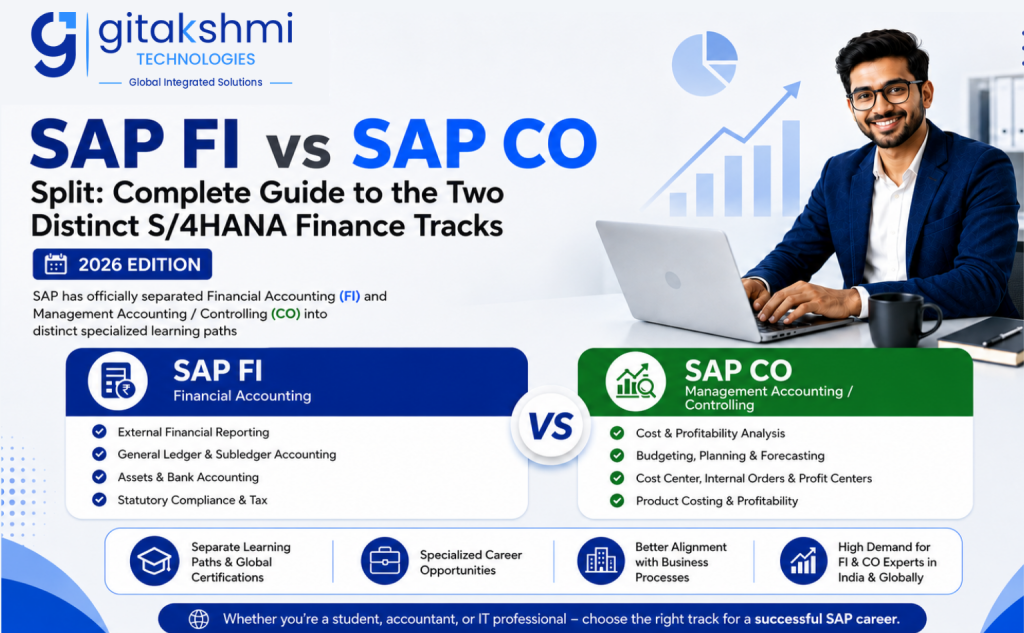

If you are a commerce graduate, an accountant, or an IT professional in India, you have probably heard everyone use the single word “SAP FICO.” For years, institutes and companies clubbed both together.
However, in the modern SAP S/4HANA Cloud ecosystem, SAP has officially separated Financial Accounting (FI) and Management Accounting / Controlling (CO) into distinct specialized learning paths, certification tracks, and functional job roles.
Whether you are planning to take up training, appear for global certifications, or switch your career to ERP consulting, this in-depth guide covers why this split happened, the detailed syllabus for both tracks, real-world business examples, and how both modules operate in modern Indian and global enterprises.
1. Why Have SAP FI and SAP CO Officially Split?
Historically in SAP ECC, consultants tried to handle both FI and CO at a basic level. But as business operations, statutory regulations (like Indian GST, e-Invoicing, TDS, and IFRS), and internal manufacturing costs became complex, a single person could rarely master both areas with deep expertise.
SAP addressed this by restructuring its official credentials and consultant journeys into two distinct pillars:
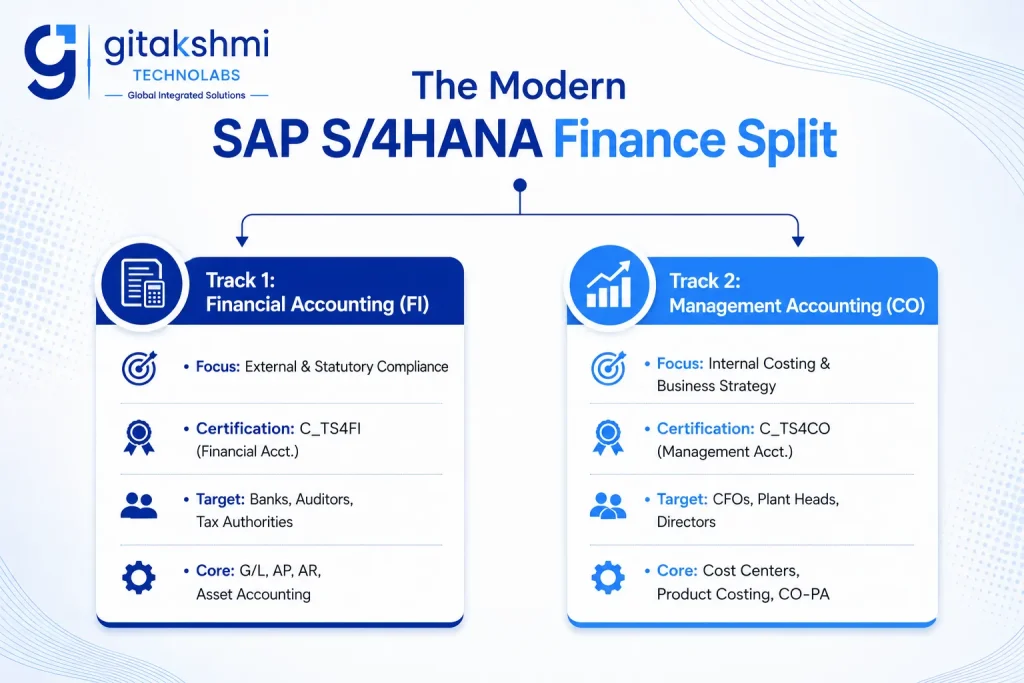
The 3 Big Reasons for the Division:
- Official Certification Split: SAP now offers separate global associate certifications: C_TS4FI (Financial Accounting in S/4HANA) and C_TS4CO (Management Accounting in S/4HANA).
- Business Specialization: Large enterprises and MNCs (like Tata, Reliance, Infosys, and Deloitte) now hire dedicated FI Specialists for statutory books and tax audits, and separate CO Specialists / Product Costing Experts for factory shop floors and margin analysis.
- S/4HANA Cloud Modular Design: While data converges into a unified table (ACDOCA), the business configurations, business rules, and user interfaces (SAP Fiori Apps) are distinctly divided into separate functional domains.
2. Head-to-Head Comparison: Financial Accounting vs Management Accounting
| Feature / Dimension | Track 1: SAP FI (Financial Accounting) | Track 2: SAP CO (Management Accounting / Controlling) |
| Primary Focus | External Reporting & Statutory Compliance. | Internal Decision-Making & Cost Optimization. |
| Governing Org Unit | Company Code (Legal Entity). | Controlling Area (Management Cost Boundary). |
| Key Stakeholders | Income Tax Dept, GST Authorities, Auditors, Banks, Investors. | Managing Directors, Operations Heads, Factory Managers, Pricing Teams. |
| Legal Obligation | Mandatory by Law (Companies Act, IFRS, US GAAP). | Optional / Discretionary (Internal management tool). |
| Key Output | Balance Sheet, Profit & Loss (P&L), Cash Flow Statement. | Cost Allocation Sheets, BOM Variances, Margin Contribution Dashboards. |
| Official SAP Exam | C_TS4FI (Financial Accounting). | C_TS4CO (Management Accounting). |
3. Deep-Dive Track 1: SAP Financial Accounting (FI)
The SAP FI track manages every single rupee or dollar entering and leaving the legal entity. It guarantees that the company’s financial books are 100% compliant with legal standards and ready for statutory audit.
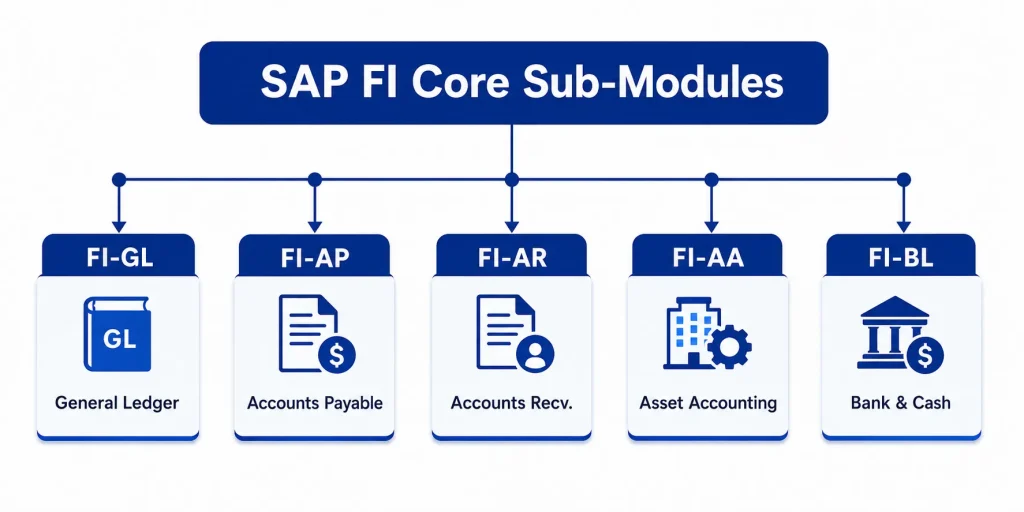
1. General Ledger (FI-GL)
The central nervous system of finance.
- Setup of Chart of Accounts (COA) (Operational, Group, and Country-specific COAs).
- Maintenance of G/L master accounts (Balance Sheet vs P&L accounts).
- Document Splitting: Automatically splits balance sheet items (like tax and vendor liabilities) across Profit Centers and Segments for zero-balance reporting.
- Management of Parallel Ledgers (e.g., Leading Ledger 0L for Local Indian GAAP, and Non-Leading Ledgers for IFRS/US GAAP).
2. Accounts Payable (FI-AP)
Manages all vendor relationships, payments, and raw material liabilities.
- Transition from vendor master to the Business Partner (BP) framework in S/4HANA.
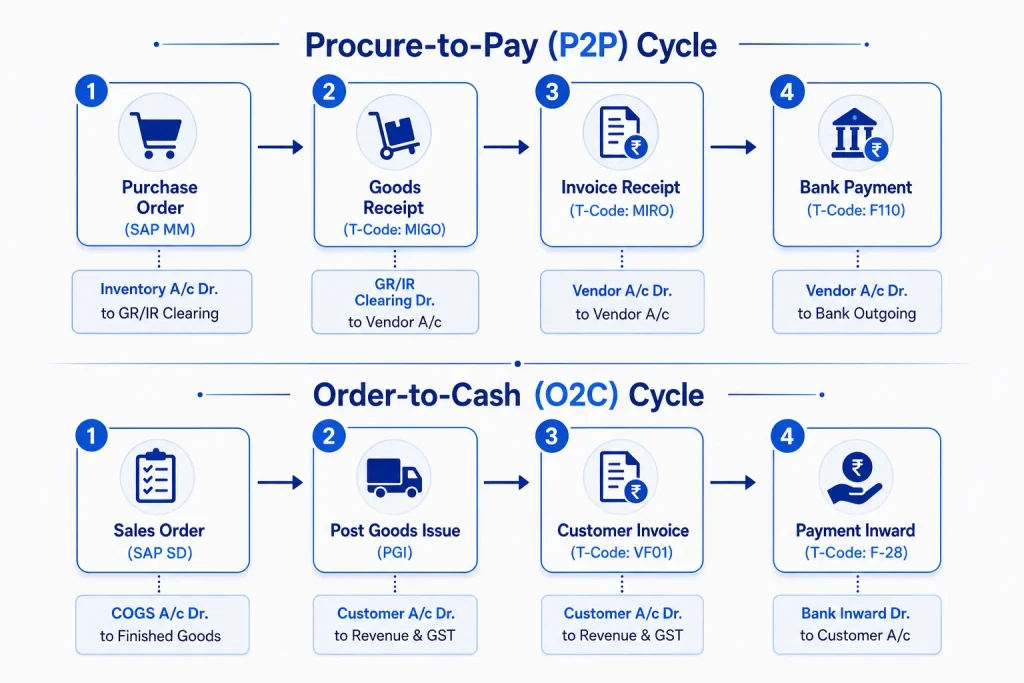
- Three-Way Invoice Matching: Validating Purchase Order (PO) vs Goods Receipt (MIGO) vs Vendor Invoice (MIRO).
- Automatic Payment Program (APP – T-Code F110): Automates bulk payments to thousands of suppliers via bank clearing files (NEFT/RTGS/SWIFT).
- Managing Withholding Tax (TDS entries under Indian Income Tax Act).
3. Accounts Receivable (FI-AR)
Manages customer billing, incoming revenue, and credit exposure.
- Invoicing and customer payment allocations.
- Dunning Program (T-Code F150): Automated dispatch of periodic payment reminder notices and calculation of interest on overdue invoices.
- Integration with Sales & Distribution (SD) for credit limit management.
4. Asset Accounting (FI-AA)
Manages fixed physical assets across plants, offices, and warehouses.
- Asset master records, asset procurement, and Assets Under Construction (AUC) capitalization.
- Depreciation Run (T-Code AFAB): Automated monthly depreciation calculations using Straight Line Method (SLM) or Written Down Value (WDV).
- Scrapping, write-offs, and inter-company asset transfers.
5. Bank Ledger & Cash Management (FI-BL)
- Petty cash books and bank master setup.
- Electronic Bank Statement (EBS): Uploading daily bank statements (MT940/CAMT formats) for automated reconciliation with internal open items.
4. Deep-Dive Track 2: SAP Management Accounting / Controlling (CO)
While FI answers “What is our overall company profit?”, the SAP CO track answers “Which product, factory plant, or customer gave us that profit, and where did we leak unnecessary cost?”
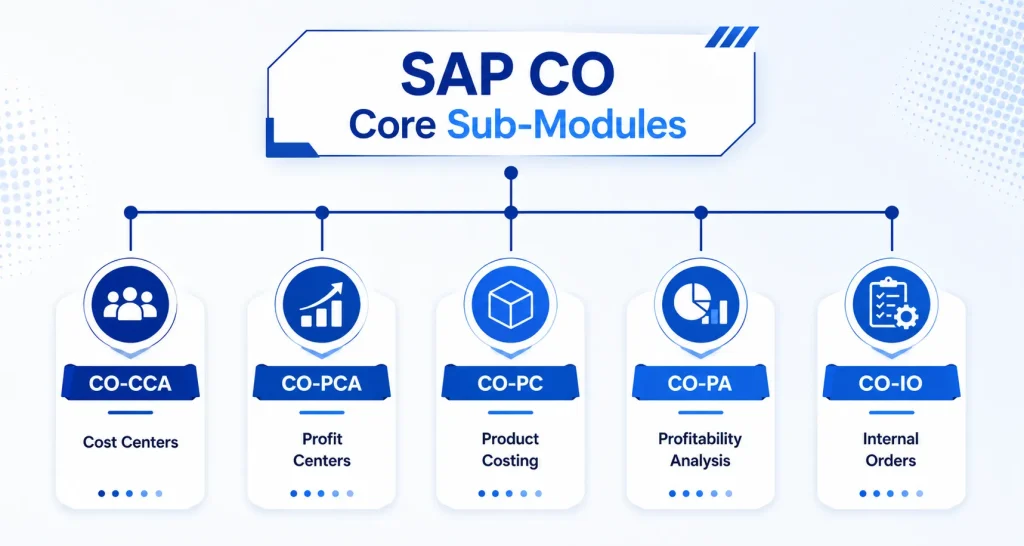
1. Cost Center Accounting (CO-CCA)
Tracks department-wise operational expenses (OPEX).
- Setup of Cost Centers for departments (e.g., HR, Administration, IT Support, Maintenance).
- Cost Allocation & Cycles: Distributing indirect expenses (e.g., electricity bills, facility rent, canteen costs) across revenue-generating production lines.
2. Profit Center Accounting (CO-PCA)
Evaluates the internal profitability of business units, regions, or product segments.
- Enables management to generate unit-wise mini P&L and Balance Sheet reports.
- Helps leadership decide whether to expand or shut down an underperforming branch.
3. Product Costing (CO-PC)
The highest-value, most complex sub-module in the manufacturing sector.
- Computes standard manufacturing costs by combining the Bill of Materials (BOM) and Routing/Work Centers from SAP Production Planning (PP).
- Variance Analysis: At month-end, calculates the variance between the standard cost estimate and the actual production cost incurred (identifying price differences, scrap loss, or machine inefficiency).
4. Profitability Analysis (CO-PA)
- Multi-dimensional contribution margin reporting for the Chief Executive and Chief Financial Officer.
- Evaluates gross margins across dimensions: by Region (e.g., North vs South India), by Channel (e.g., Direct Sales vs E-commerce), and by Customer Tier.
- S/4HANA utilizes Account-Based CO-PA as the standard default to keep it reconciled with the General Ledger.
5. Internal Orders (CO-IO)
- Used to collect and track expenses for specific, time-bound internal events or R&D initiatives (e.g., organizing a dealer summit or building a prototype).
5. The Bridge: How They Work Together via Universal Journal (ACDOCA)
Even though the functional modules, learning paths, and certifications are distinct, SAP S/4HANA eliminated the architectural friction between them using the Universal Journal (ACDOCA table).
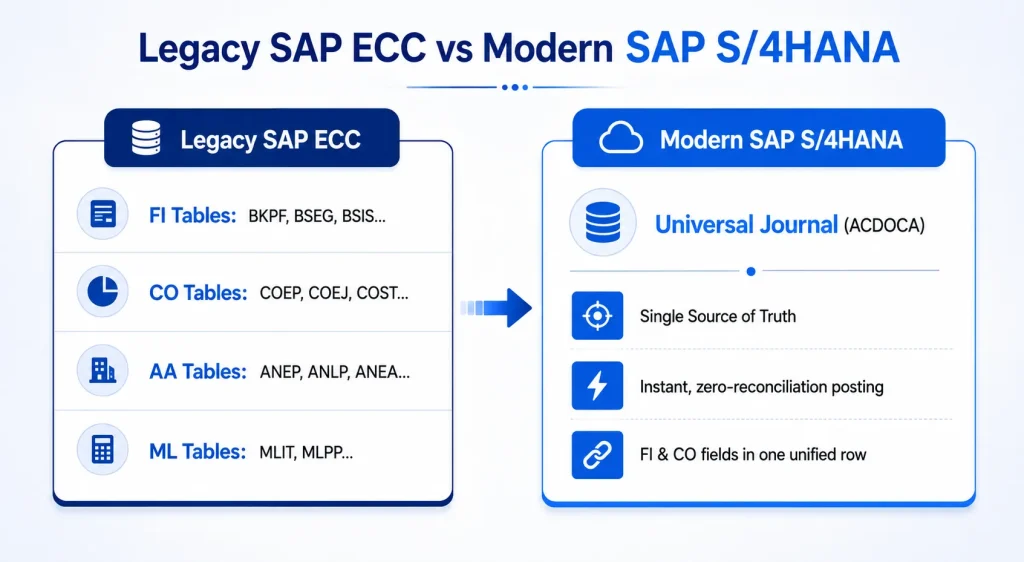
What Happens During a Live Transaction?
When a factory accountant posts an electricity bill in FI:
- The FI Specialist ensures the correct GST input credit is claimed and the vendor account is credited.
- The system automatically prompts for a Cost Center (CO field).
- The transaction writes a single unified line item into table ACDOCA containing both the FI legal accounts and the CO cost assignments.
- Result: No weekend batch reconciliation jobs required between FI and CO.
6. End-to-End Practical Business Cycles
Understanding cross-module integration is what separates a basic data-entry operator from an ERP consultant.
7. Master Cheat Sheet: Key Transaction Codes & Fiori Apps
SAP FI Operations
| Functional Area | T-Code | Core Action / Description |
| General Ledger | FS00 | Create / Edit G/L Master record centrally |
| FB50 | Post direct General Ledger Journal Voucher | |
| FBL3N | Display G/L Account line item balances | |
| Accounts Payable | BP | Create and maintain Vendor/Customer Business Partners |
| FB60 | Post Incoming Vendor Invoice | |
| F110 | Run Automatic Payment Program (APP) | |
| FBL1N | Display Vendor line items and clearing status | |
| Accounts Receivable | FB70 | Post Outgoing Customer Sales Invoice |
| F-28 | Post Customer Incoming Payment Receipt | |
| F150 | Execute Automated Dunning Run | |
| Asset Accounting | AS01 | Create Asset Master Record |
| AW01N | Open Asset Explorer (Valuation & Deprecations) | |
| AFAB | Execute Monthly Asset Depreciation Run |
SAP CO Operations
| Functional Area | T-Code | Core Action / Description |
| Cost Centers | KS01 / KS02 | Create / Change Cost Center Master Data |
| KSB1 | Display Cost Center Line Item Actual Costs | |
| KSU5 | Execute Assessment Cycle (Overhead Allocation) | |
| Internal Orders | KO01 / KO02 | Create / Edit Internal Order |
| KO88 | Settle Internal Order to Cost Center or Asset | |
| Product Costing | CK11N | Calculate Standard Cost Estimate with Quantity Structure |
| CK24 | Mark and Release Standard Cost Estimate to Material Master | |
| KKBC_ORD | Analyze Production Order Cost Variances | |
| Profitability | KE24 | Display CO-PA Line Item Documents |
8. Career Tracks, Certifications & Hiring Demand
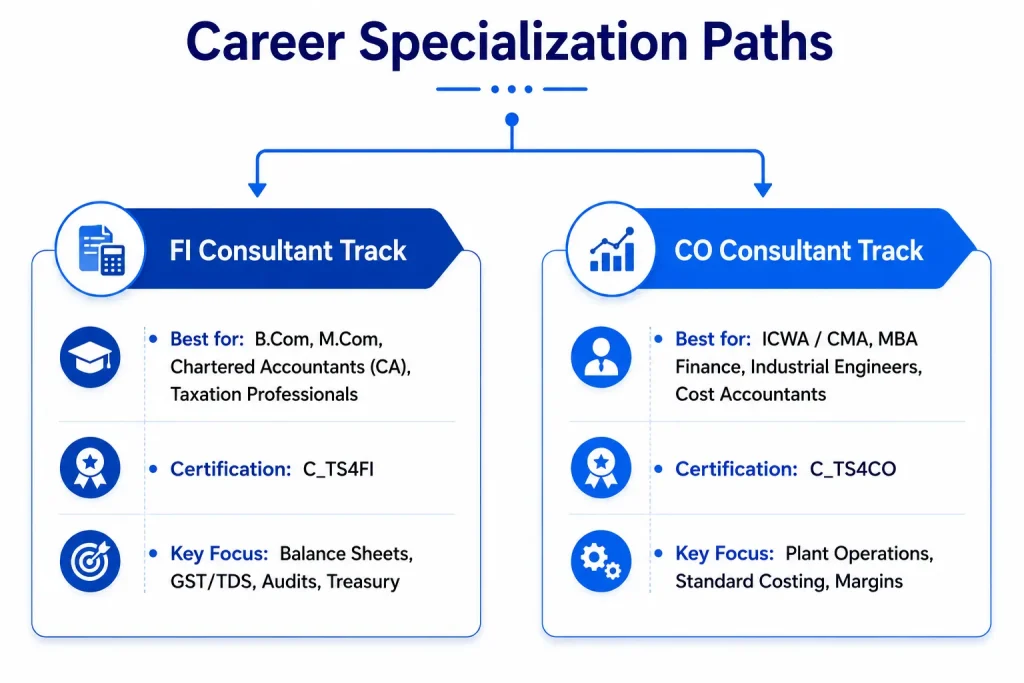
Which Track Should You Pick?
- Pick SAP FI: If your strength lies in pure corporate accounting, legal compliance, balance sheets, taxation, banking workflows, and general ledger auditing.
- Pick SAP CO: If you enjoy cost calculations, manufacturing processes, factory overhead allocations, product margin analysis, and business management reporting.
- The Full-Stack Finance Consultant: While you should start by mastering one primary track (FI or CO), learning the integration points between both makes you a complete Solution Architect capable of leading global implementation projects.
9. Frequently Asked Questions (FAQs)
Q1: Can I get a job by learning only SAP FI or only SAP CO?
Yes. In implementation projects and consulting firms, roles are frequently split. You will often see job postings specifically for “SAP FI Functional Consultant” or “SAP CO / Product Costing Consultant.”
Q2: Do I need coding or programming knowledge for these modules?
No. Both FI and CO are functional consulting tracks. They require business acumen, standard menu configuration (SPRO), and client requirement mapping. ABAP developers handle the underlying custom code.
Q3: Which certification code should I register for on the SAP Training portal?
For Financial Accounting, register for C_TS4FI (SAP Certified Associate – SAP S/4HANA Cloud Private Edition, Financial Accounting). For Controlling, register for C_TS4CO (SAP Certified Associate – SAP S/4HANA Cloud Private Edition, Management Accounting).
Understanding that SAP FI and SAP CO are two distinct pillars gives you a major advantage. You can pick the path that aligns with your domain background, clear the targeted certification, and build a focused career in modern enterprise finance.