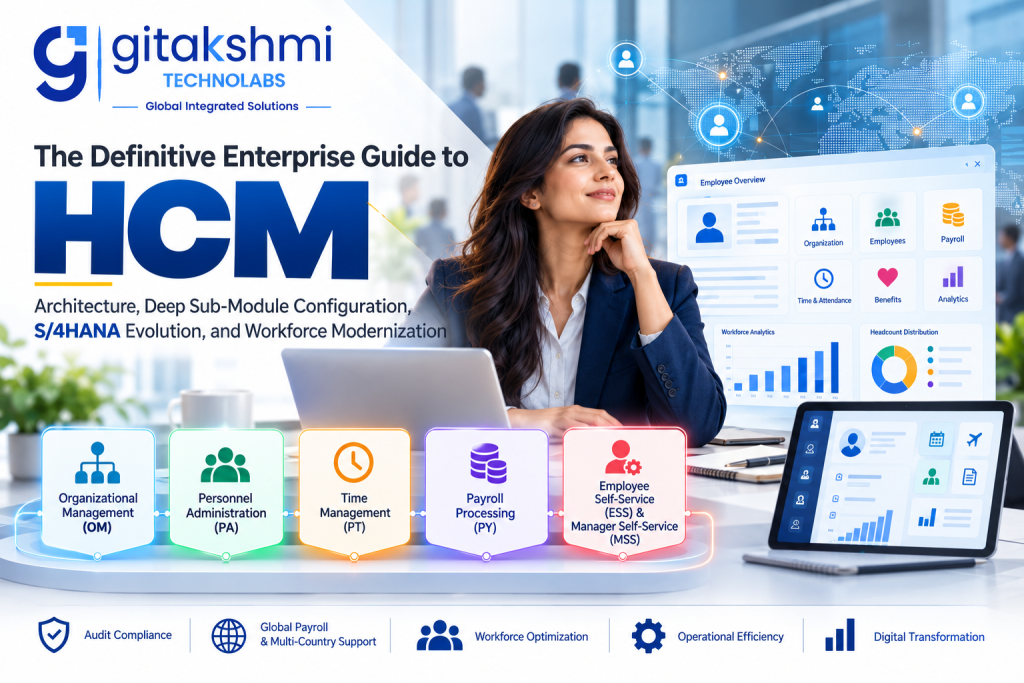
Workforce administration across global industry verticals has transcended transactional record-keeping. In an era marked by volatile supply chains, distributed workforces, shifting cross-border tax legislations, and accelerated digital transformations, human capital represents an enterprise’s primary risk vector and competitive differentiator.
At Gitakshmi Technolabs, we engineer high-performance ERP ecosystems for global enterprises. In our practice, no enterprise layer requires greater analytical precision, zero-tolerance audit compliance, and real-time ledger synchronization than SAP Human Capital Management (SAP HCM)—frequently referenced across legacy installations as SAP Human Resources (SAP HR).
While competitors often provide superficial course overviews or generic definitions, this master guide provides an end-to-end technical, architectural, and operational deconstruction of SAP HCM. Whether your enterprise is evaluating an upgrade from legacy SAP ERP Central Component (ECC 6.0) to SAP S/4HANA HCM Private Cloud Edition, establishing hybrid architectures with SAP SuccessFactors, or training functional transformation leaders, this guide serves as the definitive industry benchmark.
1. Architectural Foundation & Master Data Philosophy
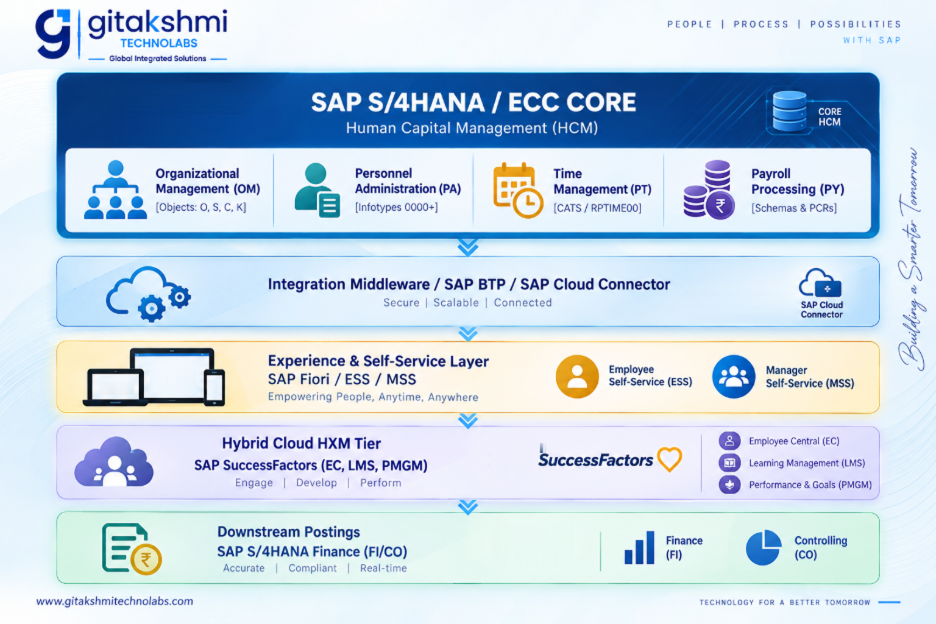
SAP HCM functions as a unified, real-time operating framework that maps the exact structural, physical, and contractual profile of an enterprise’s workforce. To comprehend its power, one must look past the graphic interface and examine its structural components.
1.1 The Philosophy of Infotypes
In conventional database architectures, employee attributes are dispersed across disconnected relational tables, making point-in-time historical reconstruction challenging. SAP HCM resolves this through Infotypes—structured 4-digit operational data containers (ranging from 0000 to 9999) that group logically related data sets.
Every single infotype record is anchored to temporal boundaries defined by a valid start date (BEGDA) and a valid end date (ENDDA). This time-dependency provides a complete chronological audit trail. When an employee receives a promotion, change of grade, or salary adjustment, historical records remain intact. Instead of overwriting previous data, the existing record is delimited, and a new validity window begins.
Master Infotype Directory for Functional Implementations:
- 0000 — Actions: Houses the lifecycle event stream of the worker (e.g., Initial Hire, Organizational Reassignment, Promotion, Salary Revision, Retirement, Separation).
- 0001 — Organizational Assignment: The architectural anchor connecting the person to the enterprise structure (Company Code, Personnel Area, Personnel Subarea) and the personnel structure (Employee Group, Employee Subgroup, Payroll Area).
- 0002 — Personal Data: Contains statutory personal demographics, including legal name conventions, tax identifiers, birth date, gender, marital status, and national identification keys.
- 0006 — Addresses: Subtyped for permanent legal domicile, temporary emergency lodgings, home-country mailing addresses, and operational posting locations.
- 0007 — Planned Working Time: Defines the individual’s baseline operational capacity, assigning work schedule rules, daily working hour expectations, employment percentages, and dynamic shift sequences.
- 0008 — Basic Pay: Connects the employee to the pay scale structure (Pay Scale Type, Pay Scale Area, Pay Scale Group, and Pay Scale Level) and details the breakdown of base wage types.
- 0009 — Bank Details: Defines payment distribution conduits, bank keys, international SWIFT/IBAN specifications, and payment methods (e.g., automated ACH, NEFT, direct wire, bank draft).
- 0014 — Recurring Payments/Deductions: Handles recurring fixed-amount allowances or deductions executed across multiple consecutive pay periods (e.g., company housing allowances, car lease deductions).
- 0015 — Additional Payments: Manages single-instance ad-hoc payments or deductions executed within a specific single pay run (e.g., annual performance bonuses, spot incentives, separation adjustments).
- 2001 — Absences: Catalogs paid and unpaid leaves (e.g., annual vacation, medical leave, casual absence, bereavement).
- 2002 — Attendances: Records positive operational inputs such as off-site business client meetings, overtime shifts, and external corporate training sessions.
1.2 Time Constraint Classes: The Rules of Data Integrity
SAP HCM enforces data integrity via Time Constraints. Consulting teams at Gitakshmi Technolabs audit these configurations to prevent overlapping records or missing operational data:
- Time Constraint 1 (TC 1): Mandatory continuous existence. The infotype record must exist at all times from the hire date to the termination date. No gaps and no overlapping validity periods are permitted. (Examples: Infotype 0000, 0001, 0002, 0007, 0008). If a record is created with an overlapping date, the system automatically delimits the prior record.
- Time Constraint 2 (TC 2): Overlaps strictly prohibited, but temporal gaps are permitted. Only one valid record may exist at any given point in time, though there may be timeframes where no record exists at all. (Example: Infotype 0267 – Additional Off-Cycle Payments).
- Time Constraint 3 (TC 3): Multiple concurrent, overlapping records and gaps are permitted. (Examples: Infotype 0022 – Education/Degrees, Infotype 0041 – Date Specifications).
- Time Constraint A, B, T: Specialized system-controlled constraints utilized for actions, infotype headers, and background processing routines.
2. Enterprise, Personnel, and Organizational Structures
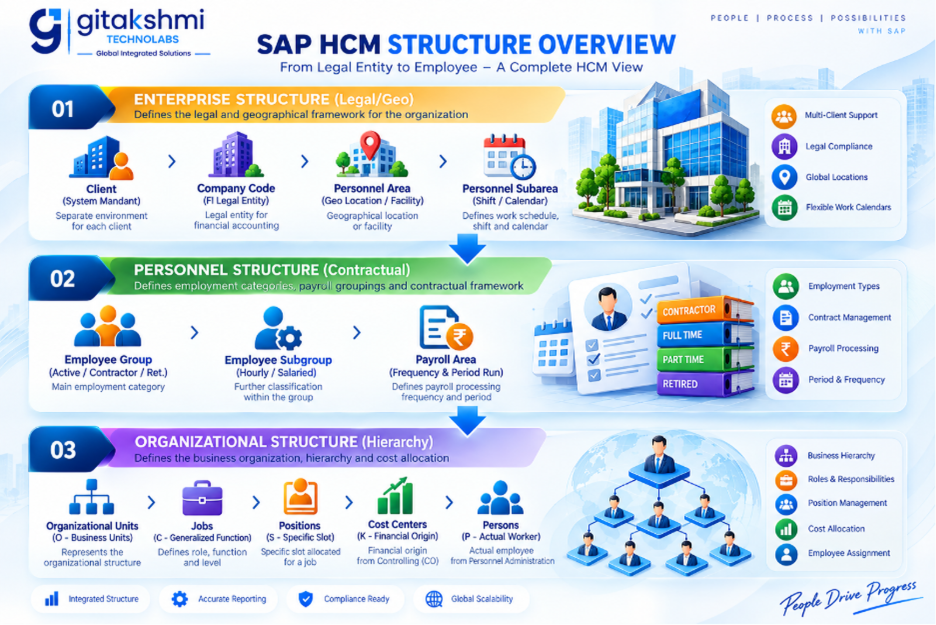
A successful SAP HCM implementation depends on correctly designing three interconnected corporate structures in Customizing (SPRO). A configuration flaw made here impacts downstream operations in Finance (FI), Controlling (CO), and Production Planning (PP).
2.1 The Enterprise Structure
The Enterprise Structure establishes the physical and legal architecture of the corporation:
- Client: The highest technical level in the SAP system hierarchy, encompassing independent master records and unified database environments.
- Company Code: A legally independent accounting entity required by statutory corporate law to maintain individual Balance Sheets and Profit & Loss statements (e.g., Gitakshmi Global India Pvt. Ltd. – 1000).
- Personnel Area: A geographic division within a Company Code representing a specific operational factory, corporate headquarters, or regional branch (e.g., Manufacturing Plant Sanand – SN01).
- Personnel Subarea: A granular structural subdivision of a Personnel Area. Crucial Architectural Rule: Public holiday calendars, work schedule assignment groupings, and legal compliance rubrics are established at the Personnel Subarea level.
2.2 The Personnel Structure
The Personnel Structure defines the legal status and operational terms of employment:
- Employee Group (EG): Classifies the workforce into broad governance bands (e.g., 1 for Active Staff, 2 for Retirees/Pensioners, 3 for External Contractors, 4 for Apprentices).
- Employee Subgroup (ESG): A critical sub-tier operating beneath the Employee Group (e.g., U1 for Salaried Management, U2 for Hourly Floor Staff, U3 for Fixed-Term Trainees). ESG settings control:
- Pay Scale Groupings and Wage Type Permissibility.
- Work Schedule Generation Groupings.
- Collective Agreement Provisioning and Time Quota Accruals.
- Payroll Calculation Groupings.
- Payroll Area: An operational grouping of employees who share the same payroll schedule and payment date (e.g., Monthly Salaried Staff, Bi-Weekly Production Crew).
2.3 The Organizational Structure (OM)
While Personnel Administration focuses on the individual, Organizational Management builds the reporting infrastructure of the business.
3. Deep-Dive Sub-Module Deconstruction
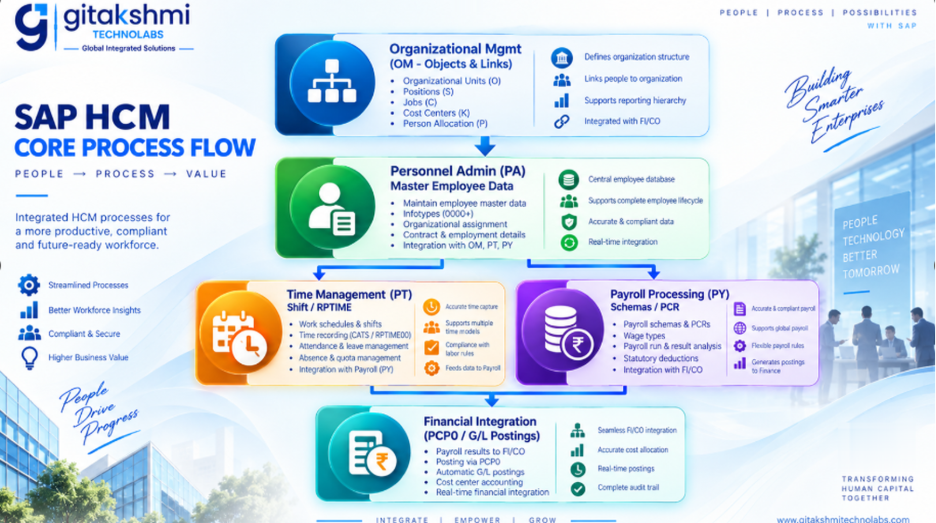
3.1 Organizational Management (OM)
Organizational Management enables workforce planning, dynamic reorganizations, and cross-functional reporting lines.
Object-Oriented Design Principles
OM uses an object-oriented data design. Every structural element is assigned a discrete Object Type code:
- O (Organizational Unit): Represents functional departments, business divisions, branches, or regional teams.
- C (Job): A generic functional blueprint defining tasks, roles, and grading levels across the enterprise (e.g., Senior Software Architect, Quality Assurance Manager).
- S (Position): Concrete, budget-allocated slots occupied by individuals. Multiple positions link to a single job blueprint (e.g., Senior Software Architect – Slot #01, Slot #02).
- K (Cost Center): Financial accounting nodes originating in SAP Controlling (CO-CCA) linked directly to Organizational Units or Positions.
- P (Person): The human worker assigned to an open position, mapped directly via Infotype 0001 in PA.
Relationship Logic and Evaluation Paths
Objects connect through reciprocal, bidirectional Relationships. When relationship A (bottom-up/active) is configured, the system automatically writes reciprocal relationship B (top-down/passive):
- A002 / B002: Reports to / Is reported to by (Line Manager hierarchy).
- A003 / B003: Belongs to / Incorporates (Departmental hierarchy).
- A008 / B008: Holder of / Is held by (Person to Position link).
- A012 / B012: Manages / Is managed by (Designated Departmental Head).
Using Evaluation Paths (e.g., O-S-P or SBOS), custom ABAP reports, workflow approvals, and Fiori dashboards traverse complex matrix hierarchies to determine dynamic approval routing for expense reimbursements, travel authorizations, and performance sign-offs.
3.2 Personnel Administration (PA)
Personnel Administration is the primary operational module for managing workforce lifecycles.
Personnel Action Configurations (PA40)
Standard corporate lifecycle events require multi-step documentation. SAP HCM coordinates these milestones through Info Groups attached to Personnel Actions via Transaction PA40:
- The Hiring Action: Sequences through Infotypes 0000 (Action), 0002 (Personal Details), 0001 (Org Placement), 0006 (Addresses), 0007 (Shift Assignment), 0008 (Salary Structure), 0009 (Bank Details), and country-specific tax infotypes (e.g., 0581/0587 for India, 0210 for the US).
- Dynamic Actions Configuration (Table T588Z): Automates downstream data updates without manual intervention. For example, when a maternity leave absence (Infotype 2001, Subtype 0200) is submitted, a Dynamic Action in T588Z can automatically delimit normal working hours in Infotype 0007 and update health coverage parameters in benefits tables.
3.3 Time Management (PT)
Time Management provides the operational data pipeline feeding Payroll. It evaluates complex shift patterns, industrial overtime agreements, and holiday frameworks.
Positive vs. Negative Time Recording Methodologies
- Negative Time Recording: Designed for administrative, managerial, and salaried personnel. The system assumes the employee works according to their planned work schedule (Infotype 0007) unless an exception—such as sick leave, business travel, or paid time off—is manually booked into Infotype 2001.
- Positive Time Recording: Essential for manufacturing, logistics, and unionized facilities. Every single operational minute is recorded via biometric terminals, turnstiles, or the Cross-Application Time Sheet (CATS). The system processes actual clock-in and clock-out punches, evaluates late arrivals, verifies break durations, and calculates overtime.
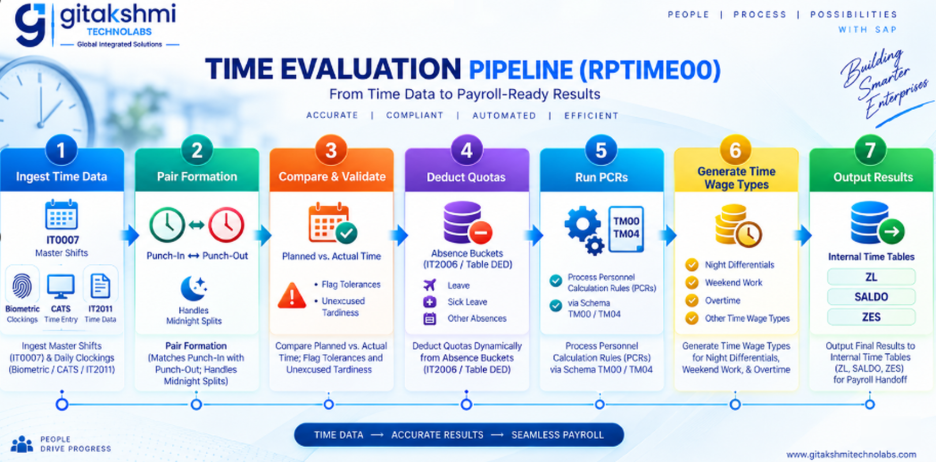
The Time Evaluation Driver (RPTIME00)
The core calculation engine of SAP Time Management is RPTIME00. Executed as a scheduled overnight batch process, it runs through standard time schemas (e.g., TM00 for positive time recording with clock times, TM04 for positive/negative recording with durations).
Key internal tables generated during time evaluation include:
- TZ / TIP: Time Interval internal Processing table.
- DZ / DIP: Daily internal Working Time specifications.
- ZES: Daily balances container (storing daily overtime hours, accrued working hours).
- SALDO: Cumulative monthly balances (storing historical time credits, banking hours).
- ZL: The final interface table containing generated Time Wage Types (e.g., Wage Type M110 – 50% Overtime Bonus, M120 – Night Differential) passed directly to the payroll processing driver.
3.4 Payroll Processing (PY)
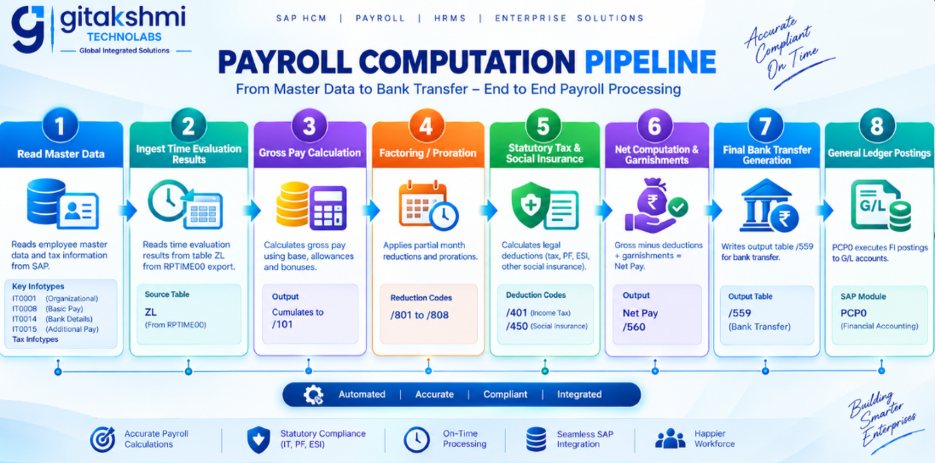
SAP Payroll is a robust multi-country gross-to-net financial engine. It executes statutory tax calculations, complex garnishments, benefits deductions, and variable incentive settlements with audit validation.
Schemas, Functions, and Personnel Calculation Rules (PCRs)
- Payroll Schemas (Maintained via Transaction PE01): Orchestrate the end-to-end execution path of the payroll driver (e.g., RPCALCX0 International, RPCALCI0 India, RPCALCU0 USA, RPCALCD0 Germany). The schema calls individual functional modules sequentially:
- Function WPBP: Populates basic pay and organizational workplace parameters.
- Function P2011 / P2001: Reads attendance and absence tables.
- Function PRT / PIT: Processes internal tables line-by-line through custom calculation rules.
- Personnel Calculation Rules (Maintained via Transaction PE02): Handle low-level arithmetic and conditional logic. For instance, rule XPPF calculates partial-period work proration when an employee joins or receives a pay raise mid-month:
 Cumulative and Statutory Technical Wage Types
SAP Payroll uses reserved technical wage types starting with a forward slash (/):
- /101 — Gross Amount: The total cumulated taxable and gross earnings base.
- /559 — Bank Transfer: The actual calculated net liquid cash distributed to the worker’s bank account.
- /560 — Net Pay: The statutory net balance remaining after subtracting taxes and deductions from the gross balance.
- /801 to /808 — Partial Period Reduction Factors: Valuation basis indicators used for calculating unpaid leave and mid-month joins.
Retroactive Accounting (The “Retro” Engine)
A core strength of SAP Payroll is its automated handling of retroactive adjustments. If an executive’s salary increase is finalized in April but backdated to January 1st, the payroll engine re-evaluates January, February, and March payroll results during the April run. It calculates the resulting variance delta and automatically credits the net difference in the April pay statement, eliminating the need for manual balance adjustments.
3.5 Employee Self-Service (ESS) & Manager Self-Service (MSS)
Modern enterprises deploy self-service interfaces via SAP Fiori, replacing older legacy SAP GUI transactions:
- Employee Self-Service (ESS): Enables employees to download secure PDF payslips, submit medical and tax declarations, manage retirement voluntary contributions, register dynamic shifts, and enter leaves via mobile apps.
- Manager Self-Service (MSS): Provides supervisors with real-time approval dashboards, budget consumption charts, departmental headcount turnover metrics, shift schedule change approvals, and performance review workflows.
4. Cross-Module Enterprise Integration Patterns
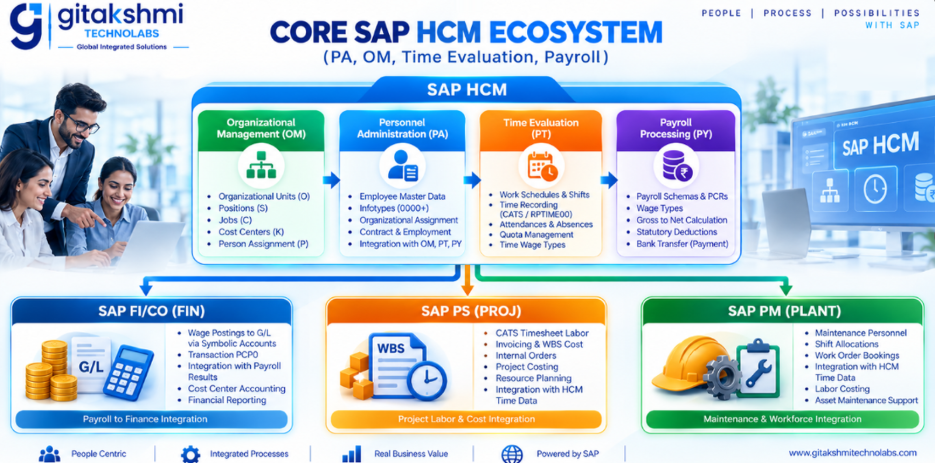
SAP HCM integrates tightly across the broader SAP ERP ecosystem. At Gitakshmi Technolabs, our consulting engagements emphasize the interdependencies between human resource events and enterprise-wide business operations.
4.1 Integration with SAP FICO (Finance & Controlling)
- Symbolic Account Mapping: The payroll module does not post directly to general ledger accounts. Instead, wage types are mapped to Symbolic Accounts (Transaction OGM1 / SPRO). These symbolic accounts map to debit/credit General Ledger (G/L) accounts in SAP Financials (e.g., Gross Salary Expense Debited, Tax Withholdings Credited, Net Bank Clearing Credited).
- Cost Center Allocations (CO-CCA): Each position in Organizational Management is linked to a Cost Center. When payroll completes, transaction PCP0 (Posting to Accounting) generates balanced financial documents, ensuring that departmental labor costs accurately reflect in management balance sheets.
4.2 Integration with SAP PS (Project Systems)
Professional services, IT delivery, and construction enterprises track billable engineering hours through the Cross-Application Time Sheet (CATS). When employees record project hours against a Work Breakdown Structure (WBS Element), the data routes to:
- SAP Time Management (PT): To calculate overtime and shift pay.
- SAP Controlling (CO): To record internal labor cost transfers.
- SAP Project Systems (PS): To generate client invoices based on billable hours.
4.3 Integration with SAP PM (Plant Maintenance)
In heavy industrial manufacturing plants, equipment maintenance relies on qualified technical personnel. Shift schedules, safety permits, and technical skill certifications configured in SAP HCM integrate with SAP PM work orders, ensuring maintenance tasks are scheduled with qualified, on-duty staff.
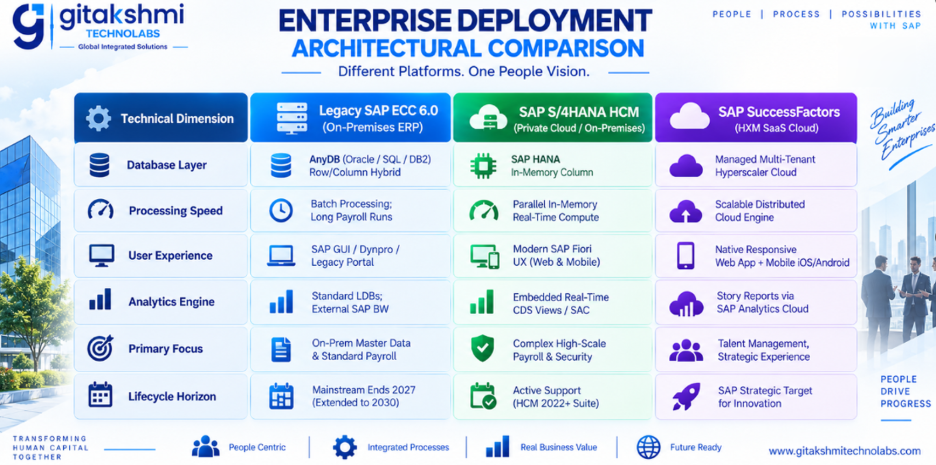
5. Architectural Comparison: SAP ECC vs. S/4HANA HCM vs. SuccessFactors
IT leaders frequently assess the right deployment strategy across on-premises, private cloud, and SaaS environments. Gitakshmi Technolabs advises clients on selecting the appropriate architecture based on compliance requirements, processing scale, and functional scope.
The Hybrid Operating Model (Recommended by Gitakshmi Technolabs)
Rather than forcing a single deployment model, leading global enterprises implement a Hybrid Architecture:
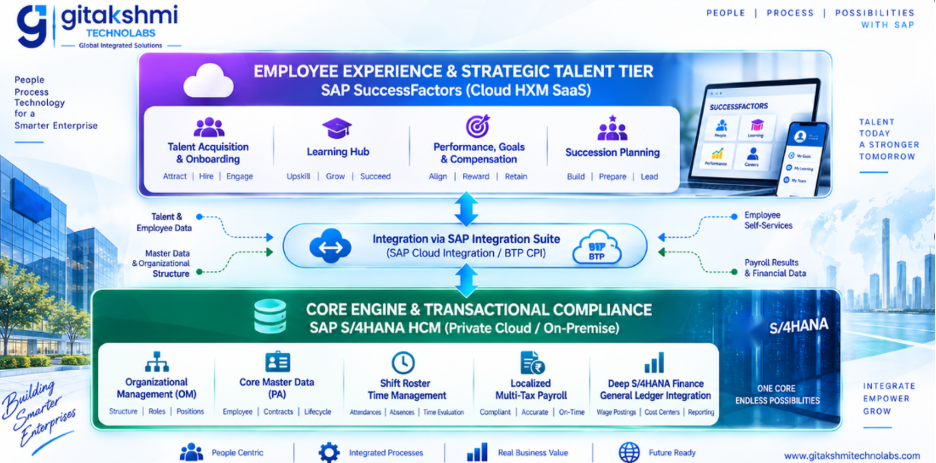
This model provides modern mobile interfaces for recruiting and performance evaluations in the cloud, while retaining the performance, data sovereignty, and security of S/4HANA for high-volume payroll and time evaluation.
6. Real-World Case Study: 15,000+ Workforce Digital Modernization
Client Profile & Challenges
A multinational industrial manufacturing enterprise with over 15,000 employees spread across 8 regional factories and 3 international engineering hubs was struggling with legacy systems:
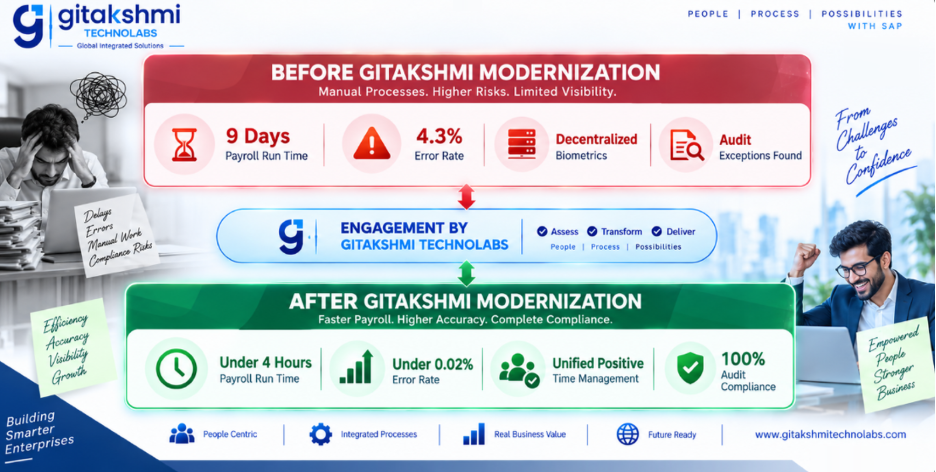
- Prolonged Payroll Cycles: Monthly payroll required 9 working days to calculate, verify, and disburse due to manual exception handling.
- Attendance Discrepancies: Attendance tracked across fragmented local biometric databases led to overtime miscalculations and an average payroll error rate of 4.3%.
- Audit Compliance Vulnerabilities: Disconnected systems made tracking historical organizational and salary changes difficult, leading to statutory audit findings.
Strategic Intervention by Gitakshmi Technolabs
Engaged as the principal enterprise transformation partner, Gitakshmi Technolabs implemented a modernization plan using the SAP Activate Methodology:
- Centralized Enterprise and Personnel Frameworks: Standardized the structural setup across Company Codes, establishing clear relationships between jobs, positions, and cost centers.
- Automated Positive Time Tracking: Connected all plant biometric turnstiles directly to SAP Time Management via daily automated batch runs of RPTIME00.
- Customized Payroll Rules: Designed localized PCRs to evaluate rotating multi-shift bonuses and statutory night allowances automatically.
- Fiori Mobile Deployment: Rolled out SAP Fiori applications across tablets and mobile devices, allowing factory supervisors to manage shift handovers and leave requests directly from the floor.
Quantifiable Business Outcomes
- Payroll Processing Speed: Total payroll calculation runtime dropped from 9 working days to under 4 hours on S/4HANA.
- Accuracy Improvement: Overtime and calculation error rates fell from 4.3% to under 0.02%.
- Direct Cost Savings: Prevented over $680,000 in annual payroll leakages and overtime discrepancies within the first fiscal year.
- Audit Readiness: Achieved a 100% clean record across subsequent statutory compliance audits.
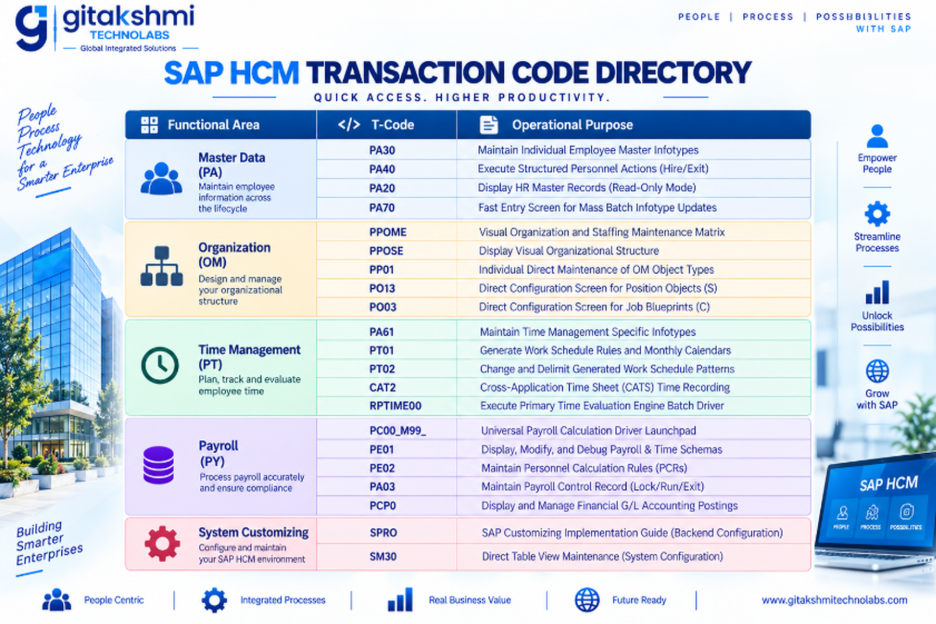
7. Practical Technical Reference: Production-Grade T-Codes
Consultants, database administrators, and functional architects rely on key Transaction Codes (T-Codes) to configure and run the SAP HCM landscape:
8. Career Architecture, Certifications, and Industry Compensation Trends
Enterprise adoption of S/4HANA and hybrid HXM architectures has sustained demand for skilled SAP HCM functional consultants and technical architects.
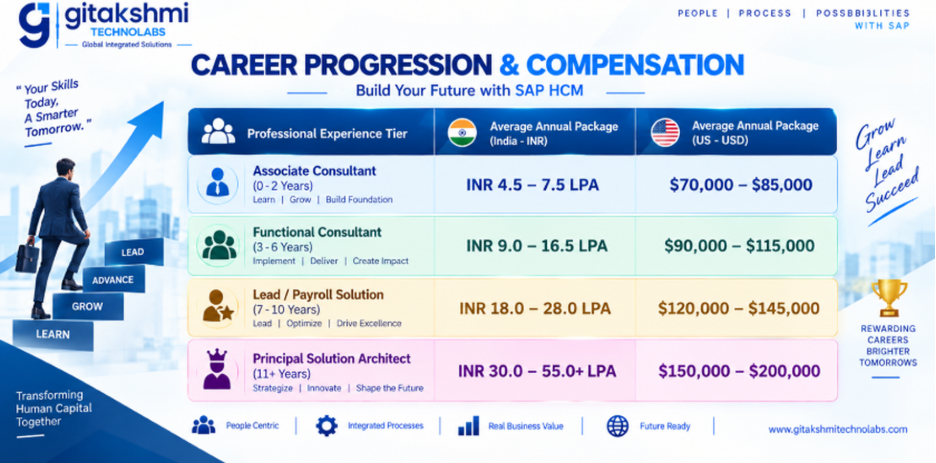
(Compensation benchmarks vary based on localized payroll configuration skills, schema development experience, and S/4HANA migration competencies).
Official SAP Certification Tracks
- C_THR12 — SAP Certified Associate – SAP HCM with ERP 6.0: The foundational certification for traditional on-premise functional consultants, covering PA, OM, Time, and basic Payroll.
- C_THR81 — SAP Certified Associate – SAP SuccessFactors Employee Central Core: The industry credential for cloud HXM transformations, essential for consultants working in hybrid enterprise landscapes.
- C_S4HNC — SAP Certified Associate – SAP S/4HANA Cloud Private Edition, Human Capital Management: Validates skills in modernizing legacy HR systems into current S/4HANA private cloud environments.
9. Comprehensive Frequently Asked Questions (FAQ)
1. What is the fundamental difference between SAP HR and SAP HCM?
SAP HR was the initial name for SAP’s human resources module in legacy R/2 and earlier R/3 systems, primarily focusing on administrative record keeping and basic payroll. As SAP developed complete tools for talent management, workforce planning, organizational design, and employee analytics, the suite was formally rebranded as SAP HCM (Human Capital Management).
2. Is on-premise SAP HCM obsolete due to the rise of cloud tools?
No. While cloud platforms like SAP SuccessFactors lead in talent development and employee experience, hundreds of large enterprises retain SAP S/4HANA HCM for core on-premise payroll, multi-shift time management, and complex localized regulatory compliance. Hybrid deployments remain a dominant enterprise strategy.
3. Can professionals from an HR or Business background transition into SAP HCM?
Yes. SAP HCM is primarily a functional module. A deep understanding of human resource workflows, national labor regulations, statutory taxation structures, and industrial shift patterns is often more valuable during system design than pure software programming skills.
4. What is the role of the Payroll Control Record (PA03)?
Transaction PA03 controls the state of payroll execution for a specific payroll area. It locks master data to prevent modifications while payroll runs, initiates simulation and production runs, and allows master data changes again once the payroll cycle is finalized and exited.
5. How does Gitakshmi Technolabs approach an SAP S/4HANA HCM migration?
Gitakshmi Technolabs employs a structured Fit-to-Standard transition model based on the SAP Activate framework. We run automated code checks on legacy schemas and PCRs, optimize custom Z-tables for the in-memory SAP HANA database, connect downstream FICO postings via modern Universal Journal entries, and deploy responsive SAP Fiori interfaces for self-service operations.
Conclusion: Partner with Gitakshmi Technolabs for Enterprise HR Transformation
SAP HCM remains the trusted operational backbone for enterprise workforce management. From organizational hierarchy modeling and shift tracking to global localized payroll calculations and financial postings, it delivers the stability, compliance, and scale required by global operations.
As enterprises plan their digital roadmaps, modernizing legacy ECC systems or establishing hybrid S/4HANA and SuccessFactors architectures requires proven functional expertise. At Gitakshmi Technolabs, we help organizations design scalable ERP ecosystems, streamline multi-country payrolls, and ensure complete regulatory compliance.
Whether you are seeking strategic ERP consulting, S/4HANA migration services, or enterprise technology solutions, connect with the consulting specialists at Gitakshmi Technolabs to build a future-ready workforce architecture.